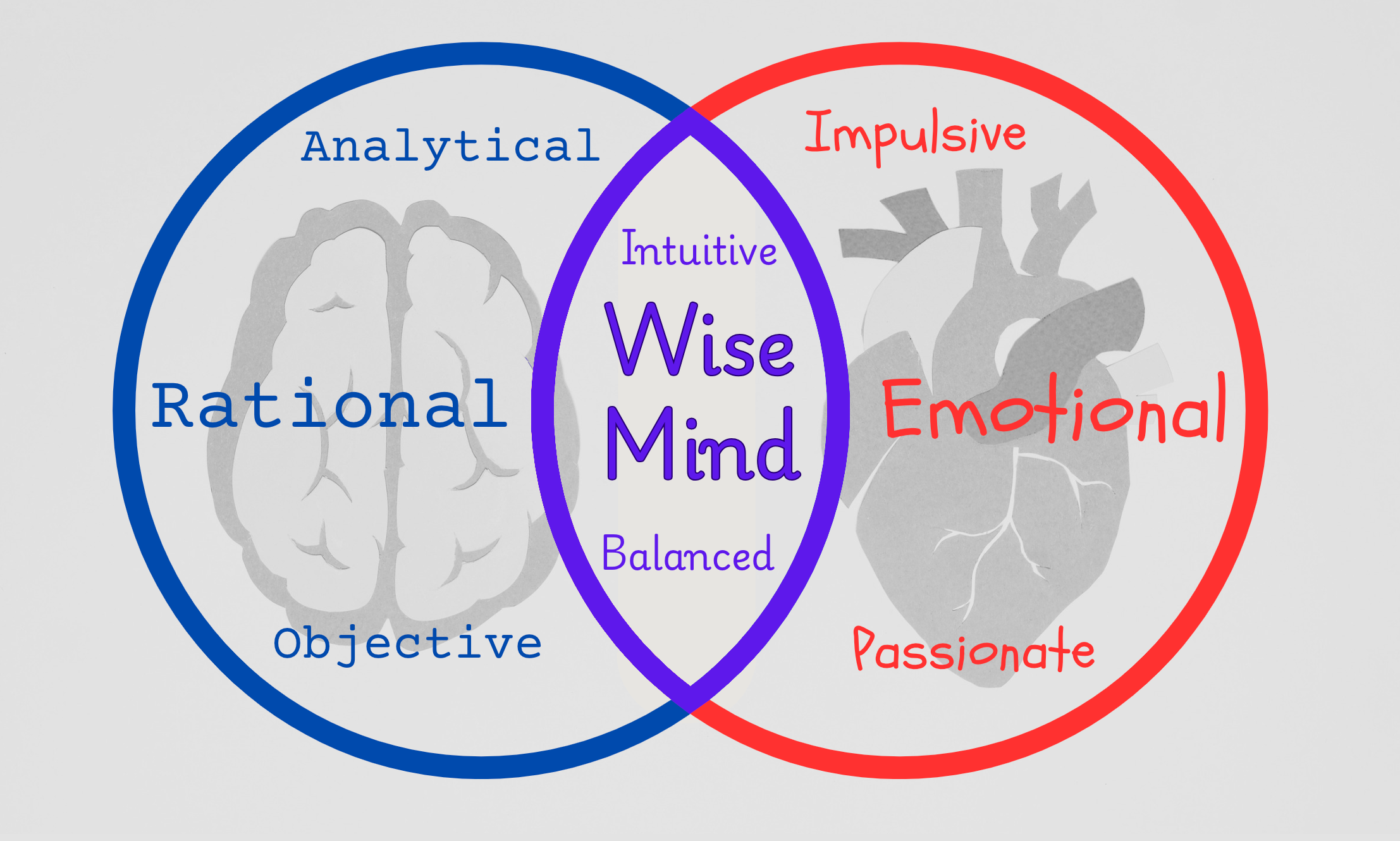
WISE Mind
“The intuitive mind is a sacred gift and the rational mind is a faithful servant.” — Albert Einstein
Wise Mind is a DBT concept that helps you find balance between emotion and logic—between what your heart feels and what your head knows. Imagine you have two inner voices: one that reacts based on feelings (like panic, anger, or sadness), and another that’s focused purely on facts and reason. Wise Mind is the place where those voices meet. It’s that deeper, quieter part of you that can hold both truth and emotion, helping you respond in a grounded, thoughtful way. It’s your internal compass—the part that knows what’s best for you, even if the path forward is hard.
When you’re in Wise Mind, things feel clearer. You might still be emotional, but you’re not acting on impulse. For example, you might think, “I’m really upset, and I know I need to take a pause before I say something I’ll regret.” In that moment, you’re honoring your emotions and choosing a response that lines up with your values. Wise Mind helps you steer through life’s ups and downs without swinging to extremes—neither ignoring your feelings nor being overwhelmed by them.
Using Wise Mind doesn’t mean being perfect or always knowing the “right” answer. It means slowing down enough to tune into both your emotional insight and your common sense. It might show up as a gut feeling or a quiet inner voice that says, “This is what I need to do.” With practice, you can access it more often—especially through mindfulness, breathing, or simply taking a moment to reflect before reacting.
A big part of Wise Mind is accepting that two things can be true at once. For instance, “I’m disappointed in myself, and I can still try again,” instead of pushing one truth aside. That “and” creates space for growth, understanding, and self-compassion.
In short, Wise Mind is the calm, steady place inside you—the one that helps you respond, not just react. It doesn’t erase the storm, but it gives you the strength to ride it out with clarity and intention. Everyone has a Wise Mind. The more you listen for it, the easier it becomes to hear.
Helpful Ways to Strengthen Wise Mind
- Mindfulness Practice: Wise Mind is easier to find when you’re grounded and present, so a simple mindfulness practice can really help. Try sitting quietly for a few minutes and only focusing on your breath or a quiet sound. When thoughts pop in, notice them and let them drift away—no need to chase them or push them out. Doing this regularly (even for just five minutes a day) strengthens the part of you that can step back, observe, and respond with clarity. Think of it like tuning a radio to get better reception of your inner voice.
- Use the “What and How” Skills: DBT suggests “Observe, Describe, Participate” (what to do) and “Non-judgmentally, One-mindfully, Effectively” (how to do it) as mindfulness strategies. For example, you might observe, “My chest feels tight and I’m thinking I’ll blow this interview,” then describe it, “There’s fear and self-doubt here.” You stay with that moment, one step at a time, without labeling anything as good or bad (non-judgmental). Over time, this practice helps you pause, reflect, and respond from a calmer, more balanced place.
- DBT suggests “Observe, Describe, Participate” (what to do) and “Non-judgmentally, One-mindfully, Effectively” (how to do it) as mindfulness strategies. Observe what’s happening inside you (e.g., “My chest feels tight and I’m thinking I’ll blow this interview”), describe it (e.g., “There’s fear and self-doubt here.”), and fully participate by acknowledging these experiences without judgment. Do this non-judgmentally (avoid calling the feelings ‘bad’ or ‘good’ – they just are), one-mindfully (focus on one thing at a time – just your inner experience in that moment), and effectively (keep in mind what works – perhaps you need to choose to ground or encourage yourself rather than criticize yourself). This structured approach helps you step out of emotional chaos and into Wise Mind by seeing clearly what’s going on inside.
- Check In with Both Sides: When you’re facing a tough decision or intense situation, try giving voice to both your emotional and logical sides. You can even write it out. Write “Emotion Mind says…” and let out all the feelings, wants, and impulses. “Emotion Mind says I’m hurt and I should just quit my job right now!” Then write “Reasonable Mind says…” and list the logical perspective. “Reasonable Mind says I need an income and perhaps I should not make hasty choices.” Then pause, take a breath, and ask, “What does Wise Mind say?” You might find a middle-ground answer like, “I’m hurt, and it’s okay to take space before deciding anything.” Try writing a final response that honors the truth in both. This exercise can help you literally see the elements you need to balance and often shows a middle-path solution.
- Use “AND” Statements: Try replacing “but” with “and” in your thinking. For example, instead of “I’m angry but I should be calm,” try “I’m angry and I can find a way to calm down.” Instead of “I did my best but still failed,” say “I did my best and I didn’t achieve my goal this time.” It’s a small shift that makes a big difference. “And” helps hold two truths at once—your feelings and your intentions—without cancelling either out. That’s exactly what Wise Mind does: it makes space for everything that matters.
- Pause – Breathe – Proceed: When your emotions are running high, give yourself permission to pause. Even a few deep breaths can help shift you out of reactivity. Try breathing in for four counts, and out for six counts. Once you’ve slowed down a bit, ask yourself, “What would a kind, wise version of me do right now?” or “What choice aligns with who I want to be?” That brief space you create with breath can be enough to help Wise Mind speak up.
- Listen to Your Intuition (Gut Feeling): Wise Mind often comes through as a quiet, intuitive sense of knowing—like a gut feeling that says, “This feels right,” or “Something’s off.” Try practicing with small decisions: imagine one option, then check how your body responds. Do you feel tense? Lighter? More settled? Then try the other option. The choice that brings calm or clarity is likely closer to Wise Mind. This kind of listening takes practice, but it gets easier the more you do it.
- Balanced Breathing or “HALT” Check: Sometimes we can’t access Wise Mind because something basic is out of balance. Use the HALT check: are you Hungry, Angry, Lonely, or Tired? If so, taking care of those needs first can make all the difference. You might also try a calming breath pattern, like the 4-7-8 breath (inhale 4, hold 7, exhale 8). A few rounds can settle your body enough to help you think more clearly.
- Talk to Yourself Like a Friend: Wise Mind speaks with compassion and honesty. When you’re caught in self-criticism or overwhelm, try saying something to yourself that’s both kind and true. It could be as simple as, “This is hard, and I’m doing the best I can.” Some people even imagine Wise Mind as a wise friend, grandparent, or even an animal—whatever makes that voice easier to hear. The goal is to replace harsh inner talk with something more supportive and grounded.
- Notice Outcomes: After making a choice from Wise Mind, take a moment to notice how it felt. Often, choices from Wise Mind lead to better outcomes or at least less regret. Maybe things didn’t go perfectly, but you avoided a meltdown, or felt more in control. Let yourself feel good about that. These small moments of success build your trust in Wise Mind. Over time, it becomes easier to recognize—and to follow—what that inner wisdom is telling you.
Example Scenario
Riley gets an email from his boss criticizing a project he spent a lot of time and effort on. Immediately, Emotion Mind kicks in—he feels angry and hurt. “This is so unfair. Maybe I’m just not good at this.” At the same time, Reasonable Mind jumps in: “Maybe the boss is right. Maybe the work really wasn’t up to standard.” These two inner voices start to pull him in opposite directions: one toward firing off a defensive email, the other toward quietly accepting blame that doesn’t feel fully fair. Neither response feels quite right, so Riley takes a breath and pauses. Instead of reacting, he decides to check in with Wise Mind—the part of him that can see both the emotion and the facts clearly. He notices what he’s feeling: “I’m upset and I feel unappreciated.” He also acknowledges the reality: “The boss gave specific feedback points.” He puts the two together: “I feel hurt, and I want to respond in a way that reflects who I am.” To get some space, Riley steps outside for a short walk. As he moves, his thoughts start to settle. He realizes the criticism stung because he cares about doing well, and he also wants to be treated with respect. After the walk, he drafts a reply: “I hear your feedback. I was disappointed because I worked hard on that project, and I want to improve. Could we meet to discuss how I can address the issues?” Before hitting send, he asks himself: “Does this express what I feel and what I want, without burning a bridge?” It does. He sends the email. Later, the meeting with his boss turns out to be helpful—not only does he get clear guidance, but his boss also respects how he handled the situation. Riley leaves feeling proud. By using Wise Mind—stepping back, reflecting, and choosing a response that respected both his emotions and the bigger picture—he managed a tough moment without reacting impulsively or shutting down. He stayed connected to his values, and it paid off.
Resources
App: MindShift CBT (iOS) (Android) by Anxiety Canada. Although based on CBT, this free app has several tools aligned with Wise Mind principles. It features quick guided exercises like “Check Your Thoughts” and “Calm Breathing” which help balance emotion and reason. The app is user-friendly and great for on-the-spot help to prevent emotional overwhelm and find a centered perspective.
Video: “Wise Mind: An Intuitive, Centered State of Mind” by DBT Skills from Experts (2020). A short animated YouTube video that explains Wise Mind using simple graphics. It walks through an example of a person using Wise Mind in a conflict, and provides tips on how to pause and find that middle ground.
Worksheet: “Wise Mind” by Therapist Aid. A helpful visual and written guide that explains the three states of mind in DBT (Emotion Mind, Reasonable Mind, Wise Mind) and includes reflection questions to help access Wise Mind.
Article: “Wise Mind” by DBT Self Help. A clear overview of the Wise Mind concept, including its definition, benefits, and how to cultivate it in daily life using DBT principles.
Article: “What Exactly Is ‘Wise Mind’ in DBT?” by Manhattan CBT. Explores how Wise Mind integrates rational thinking and emotional insight to support more grounded, effective decisions—includes practical prompts for real-world use.
Guided Practice: “Wise Mind Mindfulness Exercise” by DialecticalBehaviorTherapy.com. A brief, structured mindfulness exercise designed to help you shift into Wise Mind during emotional distress.
Book: “The Dialectical Behavior Therapy Skills Workbook” by McKay, Wood, and Brantley (2019). This self-help workbook contains a section on Wise Mind. It has easy explanations and practical exercises to recognize when you’re in Emotion Mind or Rational Mind, and how to practice shifting to Wise Mind (like the “inner wisdom” exercise).